 The Pour Journal
History
Ten years of teaching machines to pour
From a scale under a glass to a machine that writes the menu — the road to the 360, and where it goes next.
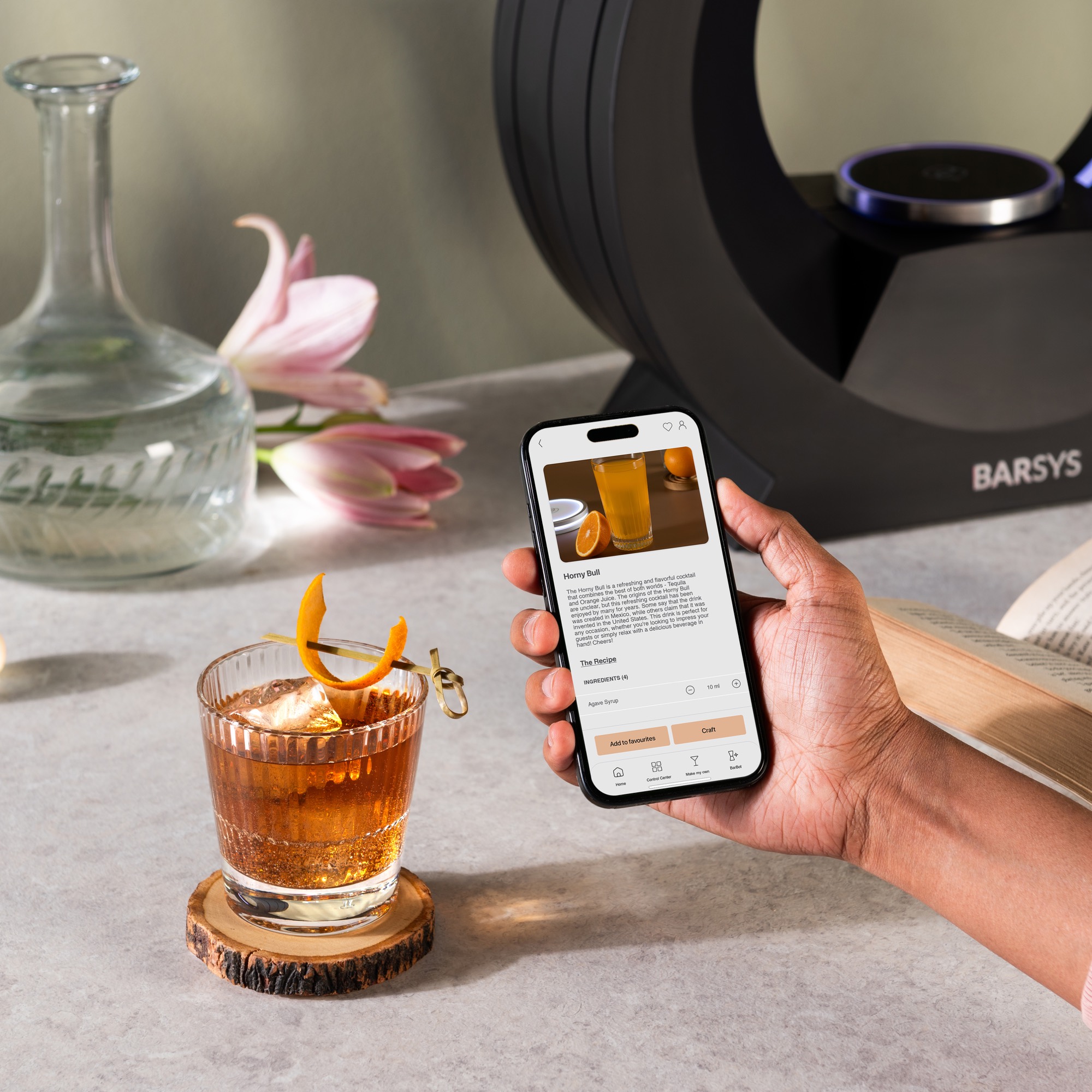
Barsys did not set out to build a cocktail machine. It set out to answer a single, slightly stubborn question: why can't a machine make a genuinely great cocktail — not an approximation, not a novelty, but a drink a bartender would nod at? Ten years later the answer has a shape, six canisters, and an app that writes the menu. Here is the road that got us here.
Every product below shipped for the same reason: it moved the same promise one step forward. Not a catalog of gadgets — one idea, kept better each year. The timeline is worth reading in order, because each instrument only makes sense as an answer to the limits of the one before it.
2016
The first question
Barsys is founded on one problem: a machine can be precise, but can it be good? The early work is all measurement — proving that a great drink is, underneath, a matter of ratio and timing.
Founded2021
Coaster — the pour, measured
A smart coaster: a scale, a ring of light, and guided recipes under any glass you already own. It could not pour for you, but it could make you pour perfectly. It proved people wanted guidance, not just automation.
Shipped2024
Barsys 360 — the instrument
The leap: six canisters, automated pours, and a form built around the glass instead of a spout. For the first time the machine could execute the whole build itself, to the milliliter, and still keep the drink center-stage.
Shipped2025
Shaker Pro — the craft, handheld
Not everything should be automated. Shaker Pro puts light-guided pours and a finishing motor in your hand, for the people who want to feel the build. The 360 and the Shaker Pro are two answers to one question — hands-off, and hands-on.
Shipped2026
Barbot — the intelligence
The software half of the instrument grows up. Barbot knows what is in your canisters, learns what you like, reads the occasion, and writes tonight's menu. The 360 pours what Barbot decides. This is the part that turns a machine into a bartender.
Now liveNext
In the lab
The next instrument is already pouring in the studio. We will only say this: it listens. More when it is ready — and not a day before.
In developmentWhat actually changed
Read the dates and it looks like a product roadmap. Read the descriptions and you can see the real progression, which is about how much of the craft the machine is trusted to hold. In 2021, Coaster held the measurement and handed you everything else. By 2024 the 360 held the entire pour. By 2026, with Barbot, it holds the decision — the part that used to require a person who had tasted ten thousand drinks and could read a table.
That is the through-line. Each release moved one more piece of expertise from the person to the instrument, without ever moving the pleasure. You still get the glass, the moment, the credit. You just stop having to be the one who memorized the ratios.
The roadmap isn't a list of products. It's one promise, kept better every year.
Why we shipped in this order
It would have been possible, in theory, to attempt the 360 first. It would also have been a mistake. We needed Coaster to prove that guidance beat pure automation — that people wanted to be made better, not replaced. We needed the 360 to prove the hardware could hit a recipe perfectly at scale. Only then was Barbot worth building, because intelligence is only useful if the body it commands is precise. Build the brain before the hands and you get a very smart machine that pours sloppily. We built the hands first.
Ten years in, the question from 2016 has a working answer sitting on counters in dens and kitchens and basement bars around the world. The machine can make a great cocktail. The next ten years are about how well.
See where the instruments are pouring now in the photo essay, or read why the 360 looks the way it does in the design essay.