 The Pour Journal
Product · Geometry
The glass, center-stage
Why a ring, why one outlet, why matte black. A short study of the geometry that makes the drink the subject.
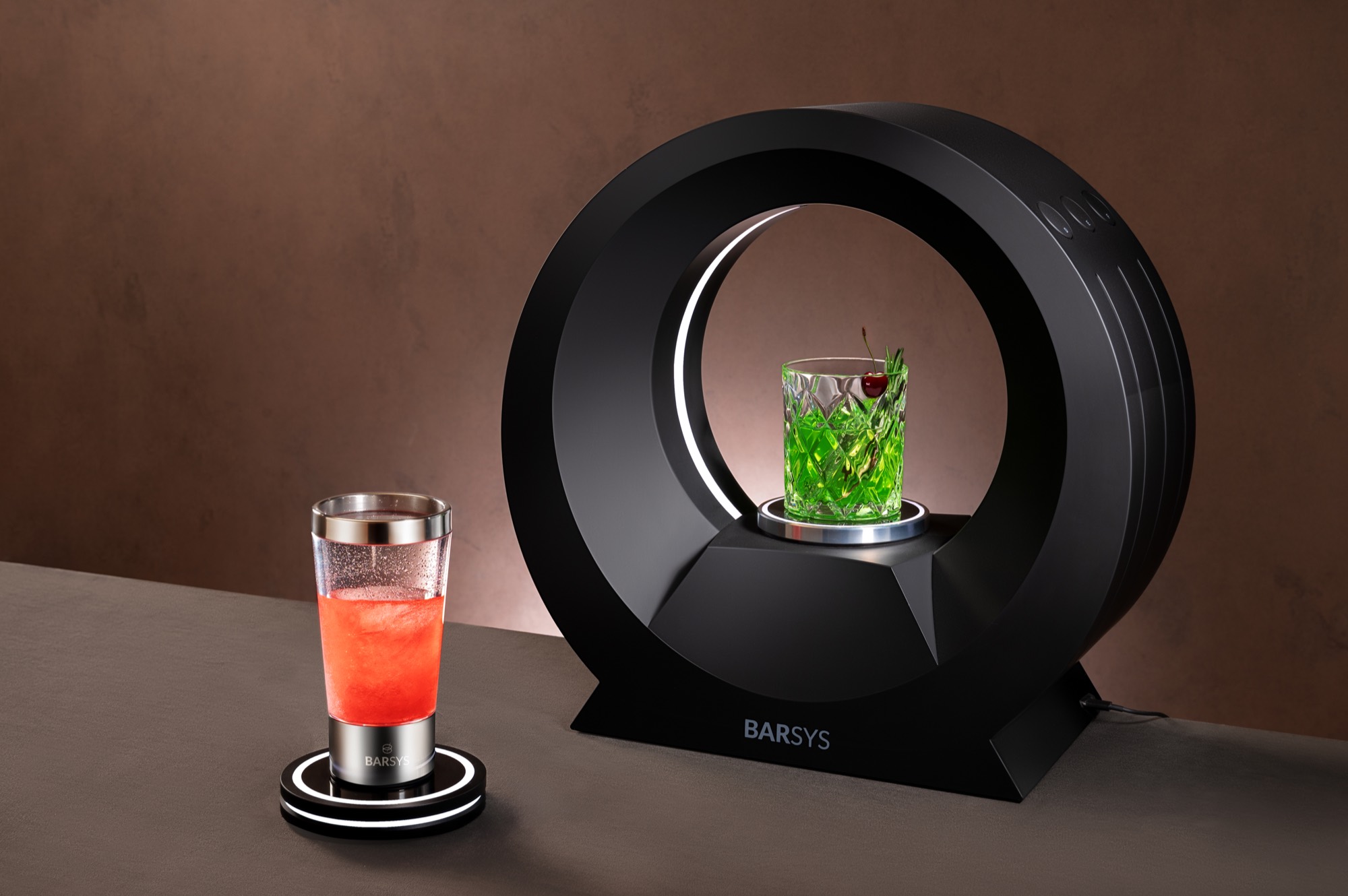
Ask most people to describe the Barsys 360 and they reach for the same word: a ring. That is the correct instinct, and it is not an accident. The circular form is the single most deliberate decision in the whole product, and almost every other choice — one outlet, matte black, near silence — follows from it. This is a short study of why the geometry is the way it is.
The whole instrument in one drawing: a ring for a horizon, one point of delivery, the glass at the focus.
A circle has one center
Start with the geometry itself. Of all the shapes a machine could take, a circle is the only one with a single, unambiguous center — and that center is exactly where the glass goes. A rectangle has a middle you have to infer. A circle points at its own focus from every angle. Sit four people around a table with a 360 on it and each of them sees the same thing: a glass held at the heart of a ring. The form does the staging automatically.
This is why the machine is not a box with a spout on the front. A front implies a viewer standing at it, like a kiosk. A ring has no front. It is designed to be surrounded, the way a table is, which is precisely the social geometry of a good drink.
One outlet, because a build is a sequence
Above the glass sits a single delivery point. It would have been easier, mechanically, to give each canister its own spout and fire them in parallel. We did the harder thing on purpose. A cocktail is not a pile of ingredients delivered simultaneously; it is a sequence — spirit, then modifier, then the bright top, each landing in order and in the right amount. One outlet forces that sequence to be honest, and it keeps the visual event singular: one stream, one glass, one moment. Multiple spouts would turn a pour into plumbing.
Craft shouldn't require construction. One outlet is the promise that it won't.
Matte black is a lighting decision
The finish is not a mood; it is optics. A glossy or light-colored body throws highlights — bright spots that the eye is hardwired to track. Every highlight on the machine is attention stolen from the glass. Matte black reflects almost nothing, so under a warm lamp the only thing that catches light is the liquid and the rim of the glass. The machine becomes a shadow with a purpose. In a dark room it nearly disappears, which is exactly the intent: a horizon you feel more than see, with the drink glowing at the center of it.
The geometry is the philosophy
Put the three together — a centered ring, a single overhead outlet, a body that gives back no light — and you have not just a look, you have an argument built in aluminum. The argument is that the drink is the subject and the machine is grammar. Every appliance before the 360 inverted that: the object was the subject and the drink was output. The ring exists to make the inversion physical, so that the first thing your eye finds, always, is the glass.
Good design, in the end, is mostly a series of refusals — the highlights you refuse to throw, the spouts you refuse to add, the screen you refuse to bolt on. The 360's geometry is what is left after all of those refusals. It looks like nothing else because almost everything else was removed.
This is a companion to the main design essay, Why it looks like nothing else.