 The Pour Journal
Engineering
How the 360 was built
From the first sketch to the final pour \u2014 a look inside the engineering and product development process that turned a cocktail idea into precision hardware.
Video coming soon
Every decision in the design of the Barsys 360 began with the same question: what does a perfect pour require? Not what is possible, but what is necessary. The answer, arrived at after years of iteration, was precision at the ingredient level and silence everywhere else.
The problem with precision
The cocktail is one of the few prepared foods where the ratio of ingredients matters as much as the quality of those ingredients. A Negroni is not approximately equal parts \u2014 it is equal parts, and the difference between 0.9 and 1.1 oz of Campari is the difference between a drink that works and one that doesn\u2019t. The machine that made the 360 possible had to hit those ratios consistently across six stations, across an evening, whether it was making the first drink or the thirty-fifth.
The calibration problem is harder than it looks. Every liquid has a different viscosity. Temperature changes viscosity. Air pressure changes it. A spirit you chilled before loading will flow differently than one you poured in at room temperature. The engineering challenge was not building a pump that could move liquid \u2014 it was building a system that could measure what came out on the other side regardless of what went in.
\u201cWe built the hands first. The intelligence only becomes useful once the body it commands is precise.\u201d
The ring as constraint
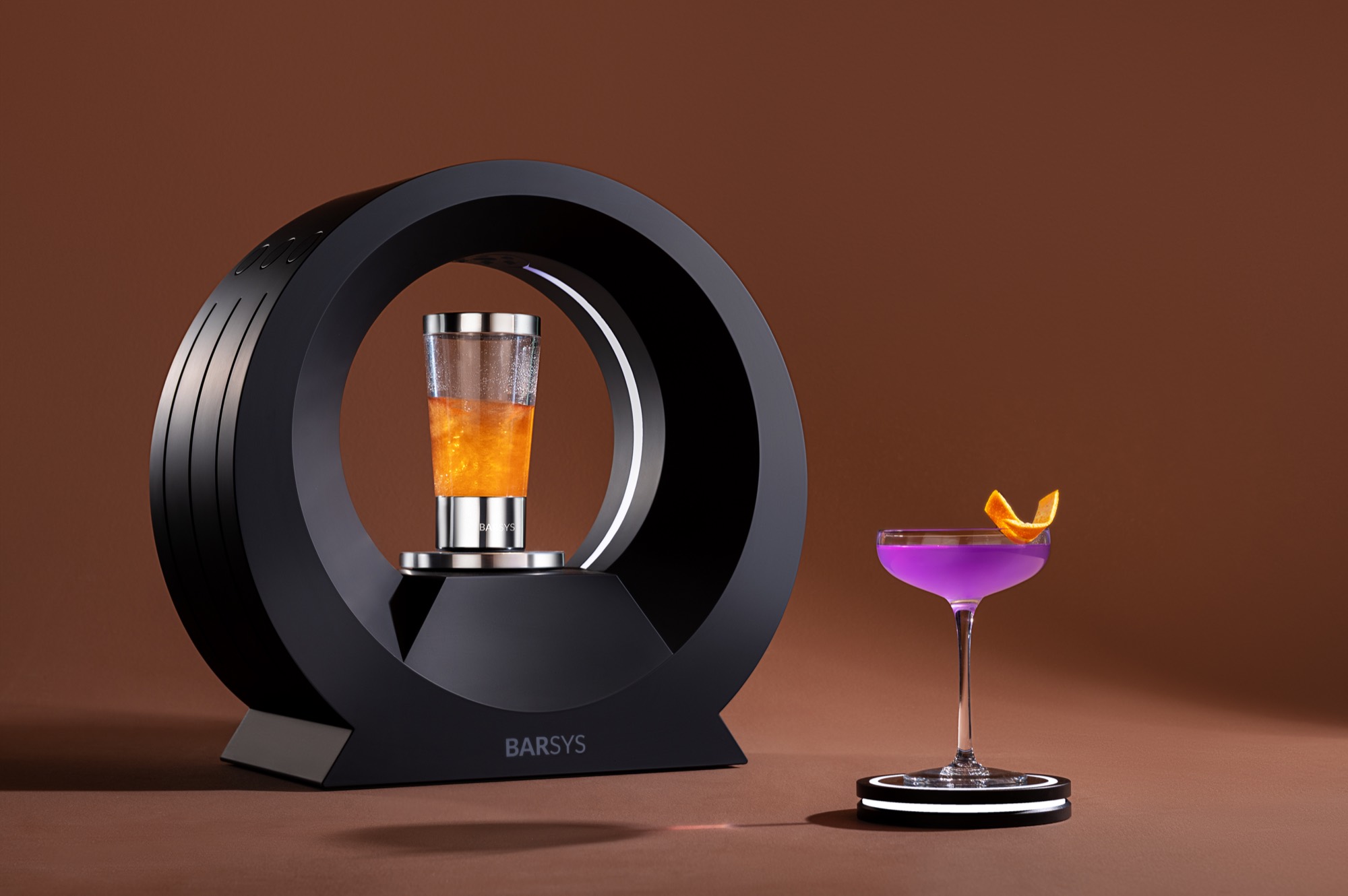
The circular form of the 360 was not a design choice imposed on the engineering. It was the engineering\u2019s answer to a brief: the machine should surround the glass, not loom over it. Six canisters arranged in a ring allows equal path lengths from each canister to the outlet, which is one of the variables that made calibration tractable. The geometry is functional first and aesthetic second \u2014 though we were pleased when it turned out to be both.
Six canisters. One outlet.
Early prototypes had multiple outlet points. They were faster, but they produced inconsistent pours when two ingredients had to arrive simultaneously \u2014 one tube would dominate. The final architecture routes all six canisters through a single outlet with a controlled sequence. The build takes slightly longer than a simultaneous pour would, but the ingredient lands in the right proportion and in the right order, which is how a bartender would do it by hand.
The single outlet also simplified cleaning. There is one path to flush, not six. The two-step app-guided rinse \u2014 water, then cleaning solution \u2014 is thorough because there is only one tube to be thorough about.
Insulation without refrigeration
The canisters are insulated, not refrigerated. This was a deliberate choice. A compressor would have added noise, weight, and a power requirement that made the machine far less portable. The target was a six-hour cold window \u2014 enough for an evening of entertaining \u2014 using insulation alone. The form factor that emerged from that constraint is a countertop appliance that runs from a single USB-C cable and needs no plumbing.
This is part of a short series on the engineering of the 360. The manufacturing story continues in where every machine is made.